
Restorative Intervention on Francis Avenue
By Elaine Hamilton, Portsmouth Mediation Service.
Restorative Intervention on Francis Avenue
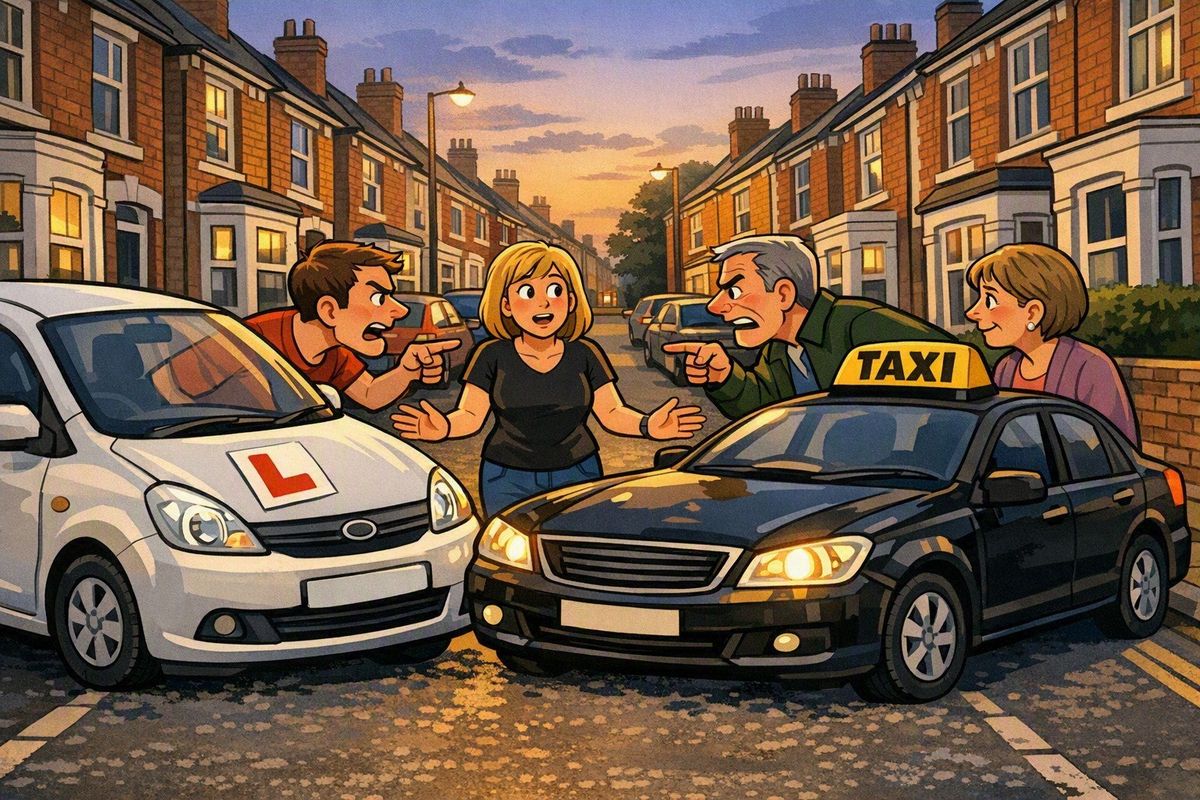
On the evening of Thursday 20 August, after a brief moment’s thought, I decided to put into practice some of the restorative skills I’ve learned through Portsmouth Mediation Service. I stepped in to help defuse an escalating altercation between two men on Francis Avenue, Southsea, and was soon joined by another concerned woman who offered immediate support.
A car full of young men, displaying an L plate on the bonnet, had stopped nose to nose with a taxi. The front-seat passenger of the younger men’s car and the taxi driver were standing in the middle of the road, squared up to one another. They were shouting, gesticulating, and moving closer step by step.
When the younger man noticed me watching from the pavement, he accused the taxi driver of having called the police. I was wearing jeans and a black T-shirt, with no hat of any kind—let alone a police helmet—so I guessed it must have been my calm stance that had given him that impression. That encouraged me to step off the pavement and join them in the road between the two cars.
“I work with Portsmouth Mediation Service,” I said. “I have no authority. I’m just seeing whether I might be able to help. I’d like to help if I can.”
I explained that Francis Avenue was built in the late Victorian or early Edwardian period, long before today’s volume of traffic could have been imagined. With cars parked along both sides of the road, there is only enough space for one vehicle to pass at a time.
“Whenever you drive up or down here, you need patience,” I said. “I’ve lived here for years. There’s no point getting impatient with this road.”
“Yes, you do need patience!” said the woman who had joined us. She quickly took on the role of backing me up in everything I said, and I gave her a broad smile of welcome. We had become spontaneous allies in preventing a needless punch-up.
I listed the practical choices drivers have to make on a road like this: deciding who will give way; waiting at a junction or in a parking space when necessary; letting a few cars pass before moving on.
The woman agreed: “Yes. Every time.”
The two men began shouting that the other should have waited, instead of driving forward until both vehicles were stranded away from any junction or passing-space. The taxi driver stepped closer to the younger man; the younger man stepped closer to him. They were now so close that one jabbed finger could have started a fight.
I moved nearer and said, “I never bother with road rage myself. This is road rage. It’s not good for us.”
“No, it’s not good,” the woman agreed. “You can’t be doing with road rage, living round here.”
“It would just get us het up every time we went this way,” I said. “And it could get us into trouble if we didn’t just let it go.”
“Yes,” she said. “Don’t get into trouble. Let it go.”
I patted the L plate on the young men’s car and asked the taxi driver how he was with reversing. Either vehicle faced a long reverse, but I suggested that the taxi driver was likely to be the more experienced. I asked the young driver of the other car whether he had learned a lesson and would wait next time. He said he would.
The taxi driver reversed carefully until he reached a space where he could pull in. The young men then drove past and continued on their way.
The woman complimented me, and I thanked her and complimented her in return.
Phew.
To have been fully PMS-style restorative, I ought to have let the men work out the solution, but, I knew there would’ve been another car or few along any moment, making the problem more tricky, so I was a little more directorial than I might’ve been, for speediness.